ChatGPT for Students (2026): 25 Smart Ways to Study Better and Save Time
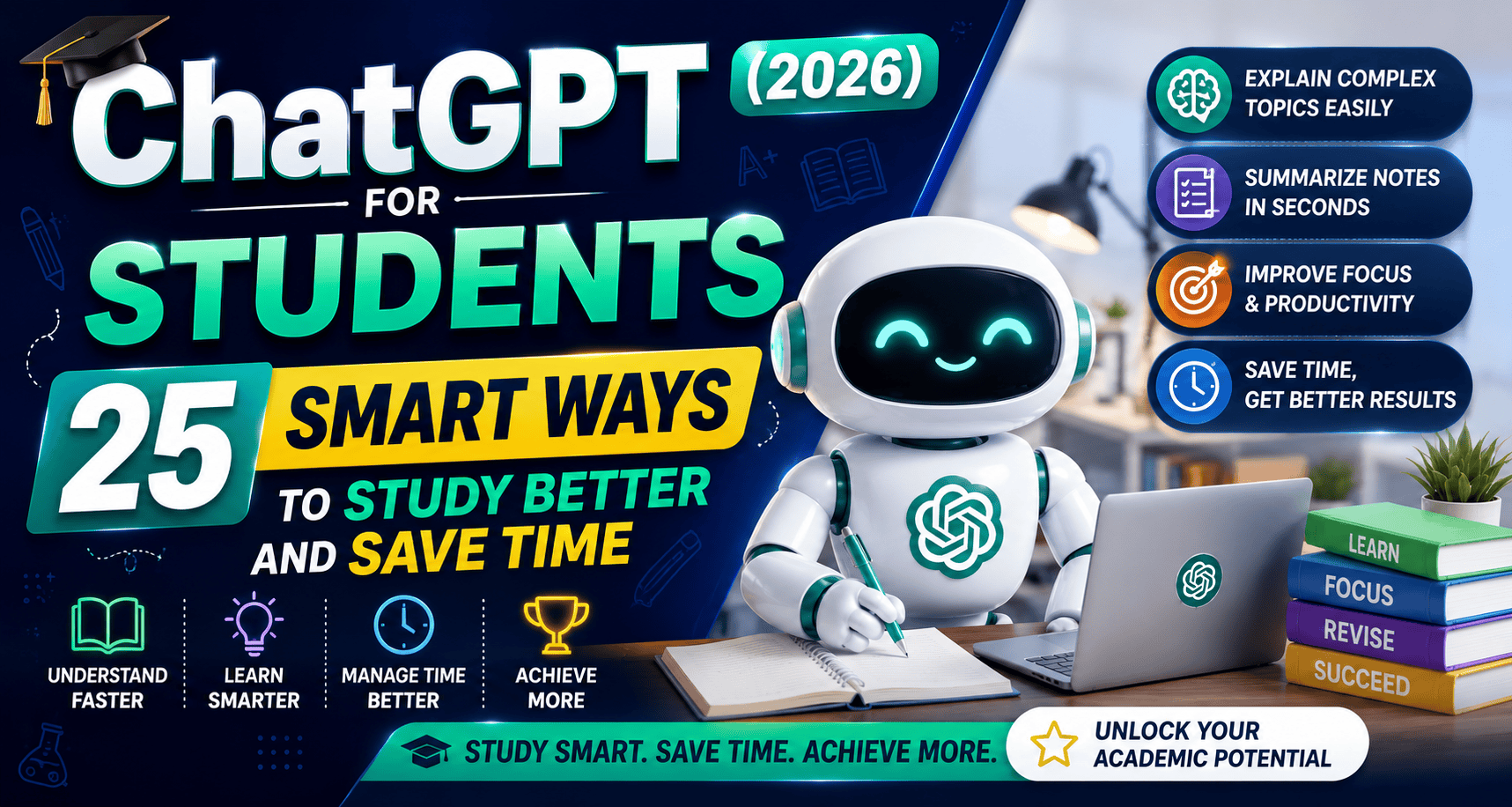
Artificial intelligence is changing how students learn, research, write, and prepare for exams. Among the many AI tools available today, ChatGPT has become one of the most popular because it can explain complex topics, generate study plans, answer questions, and help improve writing.
Whether you’re in school, college, or preparing for competitive exams, ChatGPT can become a valuable study companion when used responsibly.
This guide explores 25 practical ways students can use ChatGPT, along with ready-to-use prompts, best practices, and common mistakes to avoid.
Important: ChatGPT should support your learning—not replace it. Always verify important facts and follow your school’s academic integrity policies.
Why Students Are Using ChatGPT
Students use ChatGPT because it can help them:
- Understand difficult concepts
- Create study notes
- Practice exam questions
- Improve grammar and writing
- Learn programming
- Organize study schedules
- Brainstorm project ideas
- Summarize lengthy chapters
- Prepare for interviews and presentations
Instead of spending hours searching across multiple websites, students can ask focused questions and receive structured explanations.
1. Understand Difficult Topics
One of ChatGPT‘s biggest strengths is explaining complex ideas in simple language.
Example Prompt
Explain photosynthesis as if you’re teaching a 10-year-old. Include a real-life example.
You can also ask:
- Explain Newton’s Laws with everyday examples.
- Teach me probability from the basics.
- Explain blockchain without technical jargon.
2. Create Personalized Study Notes
Instead of copying notes manually, ask ChatGPT to summarize chapters.
Example Prompt
Summarize this biology chapter into easy-to-read study notes with headings, bullet points, and key definitions.
Well-organized notes make revision faster and help you focus on the most important information.
3. Build a Study Schedule
Preparing for exams becomes easier with a structured plan.
Example Prompt
Create a 30-day study timetable for Class 12 Physics. I can study for three hours every day. Include weekly revision sessions and mock tests.
A personalized schedule helps you stay consistent and avoid last-minute cramming.
4. Prepare for Exams
ChatGPT can generate practice questions for revision.
Example Prompt
Create 20 multiple-choice questions on World War II with answers and explanations.
You can also request:
- Short-answer questions
- Essay questions
- True or false quizzes
- Flashcards
- Case-study questions
5. Improve Essay Writing
Writing strong essays requires structure and clarity.
Example Prompt
Review my essay and suggest improvements for grammar, sentence structure, clarity, and logical flow without changing my original ideas.
This helps you learn from feedback while keeping your own voice.
6. Learn a New Language
ChatGPT can support language learning through conversation and exercises.
Examples:
- Practice English speaking
- Improve vocabulary
- Learn basic Spanish
- Translate sentences
- Correct grammar mistakes
Example Prompt
Act as my English tutor. Ask me one question at a time and correct my mistakes after each answer.
7. Solve Math Step by Step
Instead of giving only the final answer, ask ChatGPT to explain the solution.
Example Prompt
Solve this algebra problem step by step and explain why each step is necessary.
Understanding the process is more valuable than memorizing the answer.
8. Learn Programming
Students studying computer science can use ChatGPT to understand coding concepts.
It can help with:
- Python
- C++
- Java
- JavaScript
- HTML & CSS
- SQL
Example Prompt
Teach me Python from scratch. Give me one lesson each day with exercises and small coding challenges.
9. Prepare Presentations
If you need to create a classroom presentation, ChatGPT can help organize your ideas.
Example Prompt
Create a 10-slide presentation outline on renewable energy. Include key points, speaker notes, and suggested visuals.
10. Brainstorm Project Ideas
Choosing a project topic can be difficult.
Example Prompt
Suggest 20 science fair project ideas suitable for high school students. Include difficulty level and estimated cost.
This can save time and spark new ideas.
11. Improve Reading Comprehension
If a chapter feels difficult, ask ChatGPT to explain it in simpler language.
Example Prompt
Rewrite this chapter in plain English while keeping all the important concepts.
This approach is especially helpful for technical or academic material.
12. Practice Interviews
Students preparing for internships or campus placements can use ChatGPT for mock interviews.
Example Prompt
Conduct a mock interview for a software engineering internship. Ask one question at a time and provide feedback after each answer.

13. Summarize Research Papers
Research papers often contain technical language that can be difficult for students to understand.
Example Prompt
Summarize this research paper in simple language. Explain the objective, methodology, key findings, limitations, and conclusion.
This helps students grasp the main ideas before reading the full paper.
14. Create Flashcards
Flashcards are excellent for memorizing definitions, formulas, and important facts.
Example Prompt
Create 50 flashcards for human anatomy with a question on one side and the answer on the other.
These can be copied into flashcard apps or printed for revision.
15. Improve Grammar and Vocabulary
Students can use ChatGPT as a writing coach.
Example Prompt
Correct my grammar, improve sentence structure, and explain every correction so I can learn from my mistakes.
Instead of simply fixing errors, ask for explanations to build your language skills.
16. Create Revision Checklists
Long syllabuses can feel overwhelming.
Example Prompt
Create a revision checklist for Class 10 Mathematics. Divide topics into Easy, Medium, and Difficult categories.
A checklist helps track progress and identify weak areas.
17. Learn Through Real-Life Examples
Abstract concepts become easier when connected to everyday situations.
Example Prompt
Explain inflation using simple examples from daily life.
Learning through examples improves understanding and memory.
18. Practice Public Speaking
Presentations are a key part of many courses.
Example Prompt
Help me prepare a 5-minute speech on climate change. Suggest an introduction, key points, conclusion, and tips to speak confidently.
You can also ask ChatGPT to suggest likely audience questions.
19. Organize Group Projects
Group assignments become easier when tasks are clearly defined.
Example Prompt
Create a project plan for a team of five students. Assign responsibilities, milestones, and deadlines for a website development project.
This improves collaboration and accountability.
20. Learn Time Management
Many students struggle to balance classes, homework, and extracurricular activities.
Example Prompt
Create a weekly timetable for a college student with classes from 9 AM to 3 PM, two hours of self-study, exercise, and adequate sleep.
Good planning reduces stress and improves consistency.
21. Understand Career Options
Students often need guidance when choosing a career path.
Example Prompt
Compare careers in software development, digital marketing, data science, and cybersecurity. Include required skills, average responsibilities, and future opportunities.
This can provide a starting point for further research.
22. Practice Coding Challenges
Programming improves with practice.
Example Prompt
Give me five beginner Python coding challenges. After I solve each one, review my code and explain how I can improve it.
This encourages active learning rather than copying solutions.
23. Generate Mind Maps
Mind maps make complex topics easier to visualize.
Example Prompt
Create a text-based mind map for the topic “Human Digestive System” with major branches and subtopics.
You can later convert the outline into a visual diagram.
24. Prepare for Competitive Exams
ChatGPT can support structured preparation for entrance and competitive exams.
Example Prompt
Create a 90-day study plan for competitive exam preparation. Include daily targets, revision sessions, mock tests, and weekly progress reviews.
Use the plan as a guide and adjust it based on your progress.
25. Learn Smarter, Not Harder
One of the best ways to use ChatGPT is to ask it how to learn.
Example Prompt
Based on cognitive science, suggest effective study techniques for remembering information long term. Include methods like active recall, spaced repetition, and practice testing.
Learning effective study strategies can improve results across every subject.
Best ChatGPT Prompts for Students
Here are a few prompts you can save and reuse:
- Explain this topic in simple language with examples.
- Create detailed revision notes from this chapter.
- Generate 30 MCQs with answers.
- Prepare a one-week study plan for this subject.
- Review my essay and provide constructive feedback.
- Translate this paragraph into simple English.
- Create flashcards for these key terms.
- Explain my coding error and suggest improvements.
- Prepare interview questions for my chosen career.
- Summarize this article into five key takeaways.
Mistakes Students Should Avoid
Using ChatGPT to Copy Assignments
Submitting AI-generated work without understanding it can violate your school’s academic policies and reduce your learning.
Instead, use ChatGPT to:
- Learn concepts
- Improve drafts
- Brainstorm ideas
- Check grammar
- Practice questions
Trusting Every Answer Without Verification
AI can occasionally make mistakes or provide outdated information.
Always verify:
- Dates
- Statistics
- Scientific facts
- Legal information
- Medical information
Use reliable textbooks, official websites, and academic sources for confirmation.
Asking Vague Questions
Instead of:
Explain chemistry.
Try:
Explain chemical bonding for Class 10 students using simple language and real-life examples.
Specific prompts produce more useful responses.
Depending on AI Alone
ChatGPT should complement your studies—not replace reading textbooks, attending classes, or practicing problems.
Active learning remains essential for long-term success.
Frequently Asked Questions
Is ChatGPT good for students?
Yes. ChatGPT can help students understand concepts, create study notes, prepare for exams, improve writing, and learn new skills when used responsibly.
Can ChatGPT solve homework?
It can explain homework problems and guide you through solutions. However, it’s better to use it as a learning tool rather than simply copying answers.
Is ChatGPT free for students?
A free version is available, while paid plans offer additional features and higher usage limits.
Can ChatGPT help with coding?
Yes. It can explain programming concepts, review code, suggest improvements, and help debug many programming languages.
Should students rely only on ChatGPT?
No. Combine AI with textbooks, teachers, lectures, and trusted academic resources for the best learning outcomes.
Final Thoughts
ChatGPT is transforming education by giving students instant access to explanations, personalized study support, and practical learning tools. From creating study plans and revision notes to practicing coding and preparing for interviews, it can make learning more efficient and engaging.
The most successful students use ChatGPT as a study partner rather than a shortcut. They ask thoughtful questions, verify important information, and apply what they learn through practice.
When used responsibly, ChatGPT can help you study smarter, save time, and build stronger learning habits.
25 Best ChatGPT Prompts for Bloggers to Write Faster and Rank Higher (2026)

ChatGPT vs Google Gemini vs Claude: Which AI Assistant Is Best in 2026?

Best AI Side Hustles in 2026 | 20 Profitable AI Income Ideas

15 Proven Ways to Make Money with AI in 2026

Best Free Android Games in 2026: 25 Must-Play Mobile Games for Every Gamer

Best Free PC Games in 2026: 20 Must-Play Games You Can Download Today

Vivo S2 5G Review: Full Specifications, Expected Price, Features & Should You Buy? (2026)